Introduction: The Challenges of Identification in Modern Business
In today’s competitive landscape, companies face the daily, pressing need to increase speed, precision, traceability, and automation. Whether it’s managing production, optimizing logistics, streamlining the supply chain, or enhancing the retail experience, the accurate and rapid identification of products, assets, and people is fundamental.
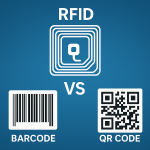
For decades, barcodes and, more recently, QR codes, have been the benchmark technologies for automatic identification (Auto-ID). They have served well for specific tasks, but modern business demands more. The need for line-of-sight reading, sequential scanning (one item at a time), and the vulnerability of printed labels often represent significant bottlenecks that hinder efficiency and innovation.
This is where RFID (Radio-Frequency Identification) technology comes into play. It’s not just a different kind of label, but a quantum leap in identification capabilities, an advanced technology designed to overcome the limitations of the past and unlock levels of performance unthinkable with traditional methods.
This article will explore why RFID is not just an alternative, but often the superior solution for companies aiming for operational excellence and seeking a lasting competitive advantage. If you are looking for concrete ways to improve your processes, RFID technology deserves your full attention.
The Intrinsic Limitations of Barcodes and QR Codes: An Obstacle to Real Efficiency
Before diving into the powerful advantages of RFID, it’s helpful to understand why traditional optical technologies, while useful, struggle to keep pace with modern demands:
- Mandatory Line of Sight: The scanner must directly “see” the code. This simple requirement drastically slows down processes, requires manual intervention for alignment, and makes it impossible to read dirty, covered, or simply out-of-direct-sight labels.
- Single Scan: Each code must be scanned individually. Imagine the time needed to manually inventory hundreds or thousands of items in a warehouse or to check the contents of an incoming pallet.
- Physical Vulnerability: Printed labels are fragile. Dirt, moisture, grease, scratches, or tears can make them unreadable, causing errors, delays, and additional costs.
- Limited Data Capacity: Barcodes store very little data. QR codes do better, but are still limited compared to RFID’s potential for complex applications.
- Static Data: Once printed, the code cannot be modified or updated.
These intrinsic limitations translate into lower speed, more manual labor, more errors, and reduced visibility into business processes.
RFID: The Technology That Overcomes Every Limit
RFID uses radio waves to communicate between a tag (a small chip with an antenna, applied to the object to be identified) and a reader. This fundamental difference – communication via radio waves instead of optics – is the source of its extraordinary advantages:
Advantage #1: Goodbye Line of Sight!
This is perhaps the most revolutionary difference. RFID readers do not need to “see” the tag. They can read through packaging, plastic, wood, and other materials (with some limitations for metals and liquids, manageable with specific tags).
- Implications: Drastically faster processes (no alignment needed), reliable reading of hidden or dirty tags, the possibility of integrating identification at previously unthinkable points in the process, greater freedom in designing automated systems.
Advantage #2: Multiple and Bulk Reading
Thanks to sophisticated anti-collision protocols, an RFID reader can identify and read hundreds of tags simultaneously in seconds.
- Implications: Extensive inventory automation (just walk by with a handheld reader or install fixed gates), instant checks of incoming/outgoing pallets and shipments, almost total elimination of data reading bottlenecks. This is a game-changer for logistics and warehouse management.
Advantage #3: Dynamic Data and Greater Capacity (Read/Write)
Many RFID tags not only store much more data than a barcode (from a simple unique ID to kilobytes of information) but also allow the data stored on the chip to be written and updated multiple times during the object’s lifecycle.
- Implications: Creation of a digital and dynamic “identity card” for each object, advanced traceability with history storage (e.g., maintenance logs, process data, temperatures experienced), “on-the-fly” product configuration.
Advantage #4: Tag Robustness and Versatility
RFID tags are available in a vast range of formats and encapsulations, designed to withstand extreme conditions:
- High or cryogenic temperatures
- Humidity, immersion in liquids
- Exposure to chemicals
- Shocks, vibrations, pressure
- Sterilization (autoclave)
- Applications on metal
- Implications: Unparalleled reliability in harsh industrial environments, outdoor applications, the medical sector, industrial laundries, automotive – wherever traditional labels would miserably fail.
Advantage #5: Integrated Security
RFID technology offers advanced security options not available in optical codes:
- Password protection for reading/writing
- Encryption of transmitted data
- Mechanisms for tag authentication and counterfeit prevention.
- Implications: Protection of sensitive data, guarantee of product authenticity, greater security in access control or payment systems.
The Impact of RFID: Transforming Business Operations (Concrete Examples)
The described advantages are not just theoretical. Companies worldwide are achieving extraordinary results by implementing RFID solutions:
- Logistics and Supply Chain: Real-time visibility of goods throughout the chain, reduction of shipping errors by up to 99%, drastic acceleration of loading/unloading and cross-docking processes, efficient returns management.
- Manufacturing: Complete product traceability (Work In Progress – WIP) without manual intervention, optimization of production line flows, automated asset management (molds, tools), and predictive maintenance planning based on actual usage.
- Retail: Inventory accuracy above 98% (compared to the 65-75% average with barcodes), drastic reduction of stock-outs and lost sales, effective theft prevention (Electronic Article Surveillance – EAS based on RFID), instant self-checkout counters. (Well-known example: Decathlon).
- Healthcare: Ensured safety in the traceability of pharmaceuticals, blood bags, and biological samples, efficient location and management of critical hospital assets (infusion pumps, wheelchairs), identification bracelets for patient safety.
- Other Sectors: More secure and fluid access control, automated fleet management, garment tracking in industrial laundries, loan management in libraries, animal traceability in livestock farming.
Implementing RFID almost always translates into greater efficiency, reduced operating costs, elimination of errors, better asset utilization, and increased customer satisfaction.
Overcoming Hesitations: Is the RFID Investment Really Worth It?
It’s undeniable: an RFID project may require a higher initial investment compared to using barcodes. However, it is crucial to consider it for what it is: a strategic investment with an often rapid and significant return (ROI). Savings from reduced manual labor, error elimination, loss prevention, and overall process optimization frequently outweigh the initial costs.
Furthermore, RFID technology is now mature, standardized, and more accessible than ever. Tag and reader costs have decreased, while performance and ease of use have increased. Relying on expert partners like Mecstar can also simplify the choice of the most suitable and cost-effective technological solution for specific business needs.
Is It Time to Evaluate RFID for Your Company?
Ask yourselves these questions:
- How much time and resources do you dedicate to manual inventories or single-item scanning?
- Do identification or shipping errors negatively impact your business?
- Do you struggle to track valuable assets or products in harsh operating environments?
- Do you desire a higher level of automation at your logistic or production control points?
- Does the lack of real-time visibility in your supply chain cause problems or missed opportunities?
If you answered “yes” to even one of these questions, then it is definitely time to seriously explore the potential of RFID.
Conclusion: The Future of Identification is Here, and It’s RFID
Barcodes and QR codes still have their place for simple applications. But for companies aiming for excellence, requiring uncompromised speed, precision, automation, and visibility, RFID technology represents the present and future of automatic identification.
It’s not just about reading a label faster; it’s about enabling smarter processes, making decisions based on accurate, real-time data, and freeing up valuable resources from repetitive, low-value tasks. Adopting RFID today is not just a way to solve current problems, but a fundamental step to remain competitive in an increasingly demanding and dynamic market.
Ready to Revolutionize Your Identification? Enter the World of RFID with Mecstar!
Don’t remain anchored to the limitations of the past. Discover how RFID technology can radically transform the efficiency and visibility of your operations.
The Mecstar team of specialists is available to help you understand the potential of RFID applied to your specific business context. We offer a wide range of RFID readers, RFID tags for every need (UHF, HF, NFC), antennas, and components to integrate this powerful technology into your systems.
Contact Mecstar experts today for:
- A free assessment of your identification needs.
- Discovering the RFID solutions best suited for your company and budget.
- Receiving personalized advice on implementing RFID technology.
Don’t wait for your competitors to make the first move. The future of efficiency is within reach. Explore RFID with Mecstar!